
Long before protein shakes, fitness bloggers on social media, and large-scale bodybuilding exhibitions, there was a man who completely changed the world's perception of the human body. His name was Eugen Sandow.
You wouldn't even guess that he was a "bodybuilder" by his appearance. Compared to modern athletes, he looked like a "average guy."
Sandow was an artist, athlete, entrepreneur, showman, and one of the first in history to turn muscle development into a global phenomenon. At a time when strength athletes were largely perceived as circus performers, he elevated physique demonstrations to an art form.

Eugen Sandow: Personal Profile
Full Name: Friedrich Wilhelm Müller
Known Worldwide As: Eugen Sandow
- Born: April 2, 1867 Birthplace: Königsberg, Prussia
- Height: ~175 cm
- Weight: ~86–88 kg during peak condition
Interesting fact: Sandow once performed strength exhibitions for European royalty and became an international celebrity long before television or social media existed.
Major Recognition
- Widely known as “The Father of Modern Bodybuilding”
- Creator of some of the first physique exhibitions in history
- Pioneer of strength performance and muscular aesthetics
- Inspiration behind the Mr. Olympia trophy design
Even today, the Sandow statue remains bodybuilding’s most iconic symbol handed to Mr. Olympia winners as the sport’s ultimate prize. That alone tells you how enormous his legacy really is.
Eugen Sandow: Biography
Before the world knew him as Eugen Sandow, he was simply Friedrich Wilhelm Müller — a boy born in 1867 in Königsberg, Prussia (modern-day Kaliningrad). He grew up in a fairly traditional middle-class family during a period when Europe was rapidly industrializing and physical culture barely existed as a concept.
His father worked as a jeweler, while his mother came from a Russian family background. Unlike many later bodybuilding legends who grew up around sports or athletics, Sandow’s childhood wasn’t centered around competitive physical training at all. In fact, his early interests reportedly leaned more toward education, travel, and culture.
As a teenager, Sandow studied across parts of Europe and became fascinated with anatomy, ancient Roman sculpture, and classical Greek art. That obsession would later shape his entire vision of muscular development. He didn’t just want to become strong — he wanted the human body to look symmetrical, artistic, and almost mythological.
Ironically, Sandow never planned to become a bodybuilding pioneer. His journey into performance began after he joined traveling circus groups and strongman exhibitions throughout Europe. At the time, circus entertainment was one of the few places where physically gifted individuals could actually earn money from athletic ability.
And Sandow quickly realized something important: crowds were just as impressed by the appearance of his physique as by the weight he could lift. That discovery changed everything.
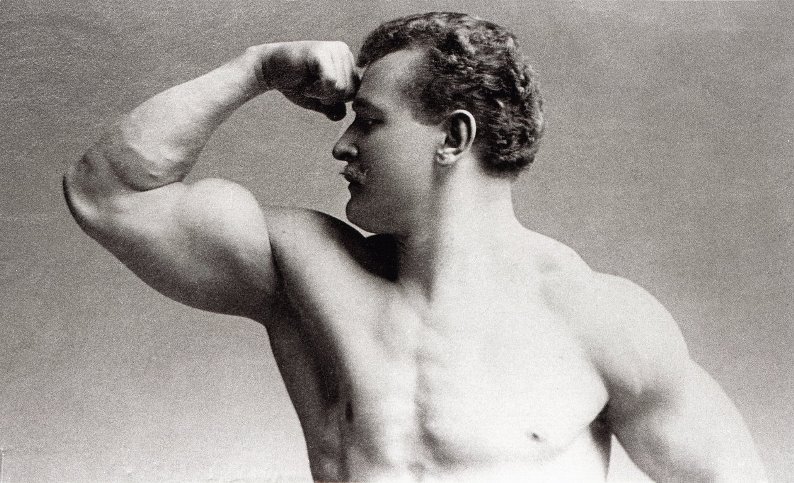
Unlike traditional strongmen who focused purely on brute force, Sandow began presenting his body almost like living sculpture — flexing, posing, and demonstrating muscular control in ways audiences had never really seen before.
The Origin of Bodybuilding
Instead of simply lifting heavy objects, he became fascinated with the proportions and aesthetics of ancient Greek and Roman statues. He believed muscular development should look balanced and artistic — not just powerful.
As he traveled across Europe performing strength demonstrations, audiences became just as fascinated by his physique as by his power. People paid money simply to see the shape and definition of his body — something almost unheard of at the time. And just like that, the foundations of bodybuilding were born.
Major Achievements
- Organized one of the first major bodybuilding competitions in history (1901)
- Published the first books on fitness and strength training
- Opened physical education institutes and gyms
- Developed one of the first exercise machines for public use
- Became one of the first international fitness celebrities
His 1901 "Great Competition" in London is often considered the first true bodybuilding competition ever organized in the world.
Let's step away from the world of bodybuilding for a second and delve into that period... It's the early 19th century, and there are no bodybuilding competitions (no Olympia, no Arnold Classic, and not even a physique competition).
Sandow created all of this from scratch! He showed the world that such competitions could exist. That such athletes could be popular. What is a body that is not only aesthetically beautiful, but can also bring fame.
Interesting fact: The Mr. Olympia trophy awarded today is modeled directly after Eugen Sandow’s physique.
Eugen Sandow’s Incredible Strength Feats
 Eugen Sandow photo
- Sandow could perform 200 push-ups in just four minutes — an astonishing display of endurance for his era.
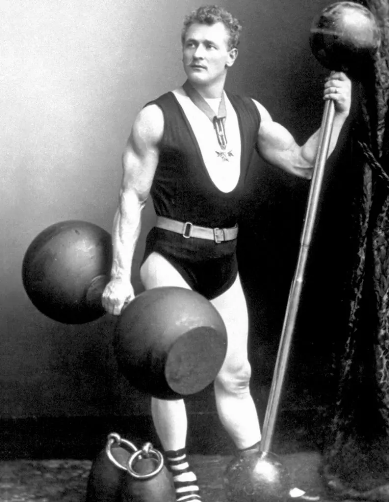
- He was able to hold two 27-kilogram kettlebells (about 60 lbs each) with his arms fully extended in front of him for several seconds.
- Supporting himself with his heels on one chair and the back of his head on another, Sandow balanced two men on his chest while simultaneously holding a 22-kilogram kettlebell (48 lbs) in one hand.
- Holding a 24-kilogram kettlebell (53 lbs) in each hand, he could stand on a handkerchief, jump into a backward somersault, and land precisely back on the same spot.
- In one of his most legendary performances, a platform carrying three horses was placed on his chest while he supported the entire weight. In another variation of the act, the platform held a piano and an orchestra consisting of eight musicians.
- In 1894, Sandow reportedly set a world record by pressing a barbell overhead with one arm. The barbell featured massive hollow globe-shaped ends, each containing a person inside. The total weight was approximately 122 kilograms (269 lbs).
- During a tour in San Francisco in 1894, Sandow famously wrestled a lion that had been fitted with a muzzle and padded gloves for safety. According to reports, the lion would charge at him while Sandow restrained and pushed the animal away.
- In 1895, Sandow performed one of his most unbelievable strength demonstrations: he lifted and pressed a 115-kilogram (254 lbs) barbell with his right hand, transferred it to his left hand, lowered himself into a squat, lay down on his back, and then stood back up again — all without lowering the weight.
Sandow's Training Philosophy: Symmetry Over Size
After all these years, when medicine has advanced so far, when athletic achievements are rewritten quite quickly, and modern bodybuilders look like titans, Sandow's name is still a household word, and his training methods are still relevant to many. Just think about it – that was over 100 years ago!
His core ideas were:
- The body should look athletic and balanced
- Strength and aesthetics should coexist
- Health matters alongside muscle
- Consistency over extremes
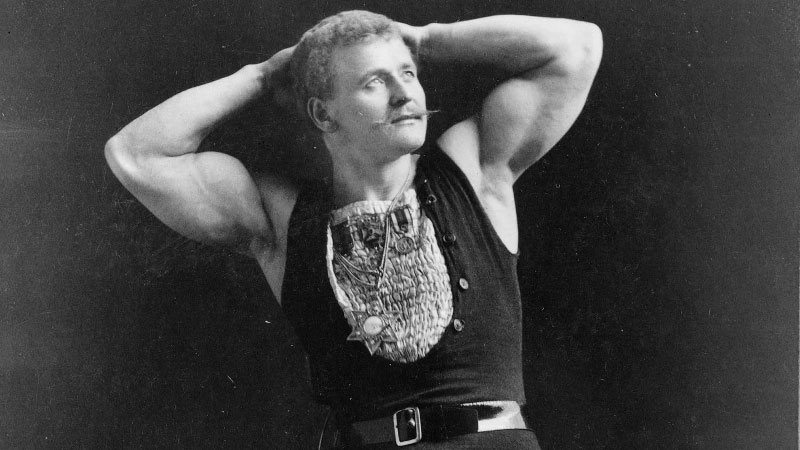
Unlike some modern approaches focused on mass gain, Sandow strove for what he called the "Gracilian ideal" – proportions inspired by classical sculpture. Athletes should have symmetrical body parameters, similar to those depicted in ancient statues. You can gain muscle mass, but you must still look aesthetically pleasing.
In many ways, he promoted classical physique principles more than 100 years before those principles even existed.
Sample Training Routine
Sandow trained using resistance exercises, bodyweight work, and early dumbbell systems.
Example:
Day 1 — Upper Body
- Dumbbell Presses — 4 sets
- One-Arm Rows — 4 sets
- Curl Variations — 3 sets
- Push-Ups — multiple sets
Day 2 — Legs & Conditioning
- Squats — 4 sets
- Lunges — 3 sets
- Walking drills
- Core work
Day 3 — Full Body Mobility
- Stretching
- Light resistance movements
- Posture work
Sandow strongly promoted posture, breathing control, and daily physical activity — concepts many lifters ignore until much later in their training journey.
Diet Example
Nutrition during Sandow's era was very different from modern bodybuilding diets: no complex supplement complexes, no flavored pre-workouts, no supplements.
Instead, his diet focused on:
- Whole foods
- Moderate eating habits
- Protein from meat, eggs, and dairy
- Consistency over extremes
Interesting fact: He was one of the first athletes in history to monetize fitness through books, equipment, and public appearances.
Sandow's Steroids
 Eugen Sandow photo
Bodybuilding existed during Eugen Sandow's lifetime long before the development of anabolic steroids.
Modern anabolic compounds such as testosterone derivatives, Dianabol, or nandrolone simply didn't exist. Testosterone itself wasn't isolated until decades after Sandow's death. Therefore, naturally, he didn't take any steroids or peptides.
Sandow's bodybuilding achievements were due to:
- Strength training
- Physical labor
- Genetics
- Nutritional discipline
- Years of intense training
This aesthetic legacy still influences bodybuilding today, especially in classical bodybuilding circles.
Conclusion
Eugene Sandow wasn't just ahead of his time. His combination of strength, aesthetics, discipline, and spectacle laid the foundation for everything that bodybuilding eventually became.
Everything that modern bodybuilding takes for granted—bodybuilding competitions, posing programs, training systems, fitness marketing, public speaking—can be traced back, in one way or another, to Sandow's influence.
Not bad for the man who started this movement in the 1800s. What do you think?
————————————————————————————————————————
Thanks for reading, dear athletes!
As for the price of anabolic steroids, they vary on average and depend on the manufacturer. But with us, you can buy high-quality medications and supplements at the best prices with fast delivery throughout the US and Europe. Visit our official website, AnabolShop.org, and believe me, it’s worth it!
Subscribe to our news and article channel on Telegram!
- News - https://t.me/anabolshops
- Article channel - https://t.me/+sS0shaQLnmMwYTEy
We hope you enjoyed the article and thank you for reading.
Good anabolism to all athletes!